
Maximizing Returns: Navigating the ROI of Your Talent Applicant Tracking System
In the competitive talent acquisition landscape, the efficiency and effectiveness of your recruitment processes are paramount. An Applicant Tracking System (ATS) is a cornerstone technology that streamlines hiring by automating administrative tasks, enhancing candidate experience, and providing actionable insights to improve recruitment strategies.
But how can organizations ensure they maximize the return on investment (ROI) from their ATS? This exploration delves into how ATS can amplify your recruitment ROI, the significance of identifying key metrics, and a step-by-step guide to calculating your system’s financial impact.
How does ATS Maximize Your Return on Investment?
An ATS maximizes ROI by reducing time-to-hire and cost-per-hire while improving the quality of hires. By automating the initial screening of candidates, the system can quickly identify and forward the most suitable applicants, reducing the workload on human resources. This efficiency accelerates the hiring process and allows teams to allocate their time to more strategic tasks, such as engagement and onboarding, further enhancing the value derived from each hire.
Why Identifying Metrics Matter in the Process of Measuring ROI of ATS?
Identifying the right metrics is crucial in measuring the ROI of an ATS because it provides a quantifiable basis for evaluating its effectiveness. Key metrics such as time-to-hire, cost-per-hire, and quality of hire offer insights into how well the ATS streamlines recruitment processes, optimizes costs and contributes to acquiring top talent. By focusing on these metrics, organizations can make data-driven decisions to continually refine their recruitment strategies and enhance their ATS’s ROI.
Steps to Calculate the ROI of an Applicant Tracking System
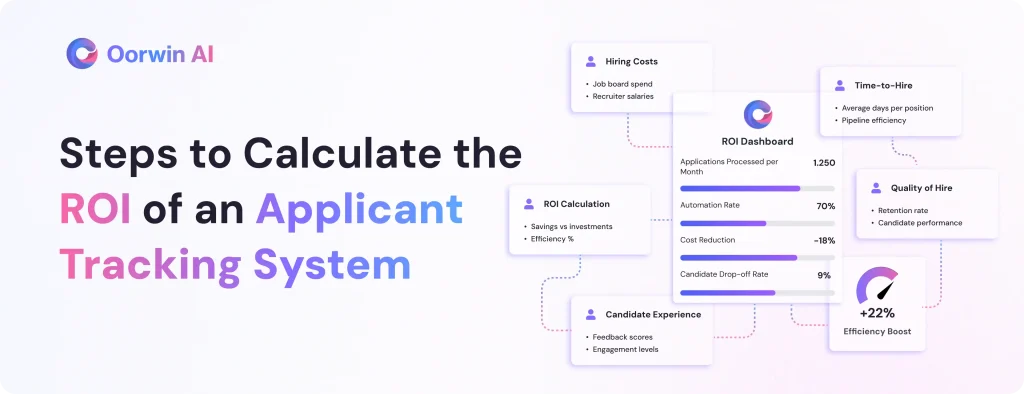
Calculating the ROI of an Applicant Tracking System (ATS) is crucial for understanding its value to your recruitment process. By evaluating specific metrics, organizations can quantify the system’s impact on improving efficiency, reducing costs, and enhancing the quality of hires.
1. Define Your Recruitment Budget
Understanding your recruitment budget is the first step in calculating the ROI of your ATS. This includes all costs associated with your recruitment process, including advertising job postings, recruiter salaries, and third-party recruiter fees. A clear budget sets the baseline for assessing how well the ATS can optimize spending.
2. Calculate the Time Taken to Hire
The time taken to hire is a critical metric for ROI calculation. A shorter time-to-hire means faster staff replenishment and indicates the efficiency of your recruitment process. Calculating this metric before and after implementing an ATS can highlight the system’s impact on speeding up your hiring cycle.
3. Assessing the Worth of a Quality Hire
A quality hire brings significant organizational value, contributing to higher productivity, better team dynamics, and reduced turnover rates. Evaluating the worth of a quality hire involves comparing the performance and outcomes of hires made with and without the ATS, providing insights into the system’s effectiveness in improving the caliber of recruits.
4. Calculating Outside Expenses
Outside expenses, including costs for additional recruitment tools or services that complement the ATS, must be accounted for in the ROI calculation. Understanding these expenses helps assess the total investment in the recruitment process and the role of the ATS within this broader context.
5. Applying the ROI Formula for ATS
To calculate the ROI of an ATS, subtract the total investment in the ATS (including system costs and outside expenses) from the total value generated by the system (such as reduced cost-per-hire and increased value of hires), divided by the total investment. This formula provides a clear picture of the financial return on your ATS investment.
Advanced ATS Features to Look For that Increase ROI
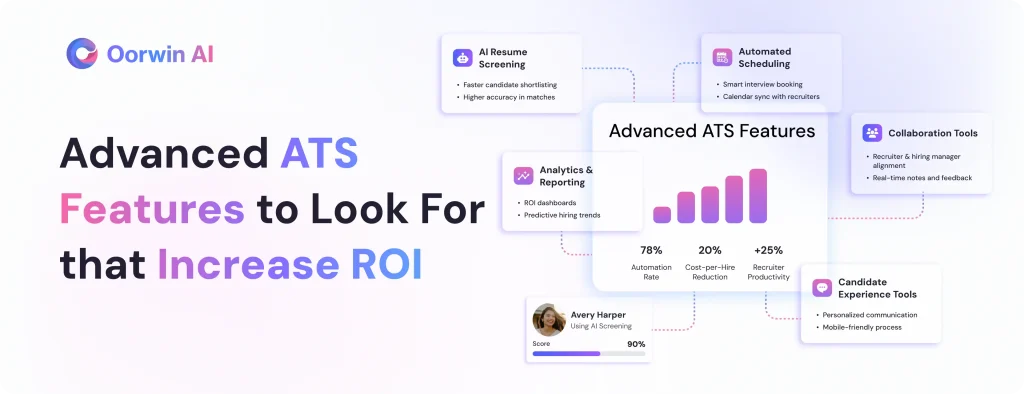
Exploring advanced Applicant Tracking Systems (ATS) features can significantly increase your recruitment ROI. These features not only streamline hiring processes but also enhance candidate experience, improve the quality of hires, and reduce overall recruitment costs, thereby offering a competitive edge in talent acquisition.
1. Automated Candidate Screening and Ranking
Automated candidate screening and ranking dramatically streamline recruitment’s initial phases. This feature efficiently filters and prioritizes candidates by setting predefined criteria, ensuring only the most fitting prospects are considered for further evaluation. This automation significantly reduces manual screening time, allowing recruiters to focus on engaging with top-tier candidates and enhancing the hiring process’s speed and effectiveness.
2. Integration with Social Media and Job Boards
Seamless integration with social media platforms and job boards expands the reach of your recruitment efforts, tapping into a broader talent pool. This feature simplifies job postings and candidate sourcing, making it more efficient by automating the distribution of job listings across multiple channels. By leveraging a more comprehensive network, organizations can attract a diverse range of candidates, improving the chances of finding the perfect fit.
3. Mobile Optimization for Applicants and Recruiters
Mobile optimization is crucial in today’s recruitment landscape. It enhances the candidate experience by allowing job seekers to apply easily from mobile devices. For recruiters, it enables hiring process management anytime, anywhere, ensuring no opportunity is missed. This accessibility improves engagement rates and facilitates a more dynamic and responsive recruitment process.
4. Customizable Career Pages and Application Processes
Offering customizable career pages and application processes allows organizations to create a unique and seamless candidate journey that reflects their brand identity. This customization improves applicant engagement and conversion rates by providing a straightforward, personalized application experience. It also helps attract candidates who are a better cultural fit for the organization.
5. Analytics and Reporting Tools
Analytics and reporting tools deliver critical insights into the effectiveness of recruitment strategies. By analyzing data on key metrics, organizations can identify bottlenecks and areas for improvement, enabling them to make informed decisions to optimize their recruitment processes. This data-driven approach leads to more efficient hiring and better alignment of recruitment strategies with organizational goals.
6. AI and Machine Learning Capabilities
AI and machine learning enhance recruitment by automating complex tasks, such as matching candidates with job descriptions and predicting hires’ success. This technology can sift through vast amounts of data to identify the best candidates, reducing bias and improving the quality of hires. It also streamlines the recruitment process, making it more efficient and effective.
7. Onboarding Integration
Integrating the ATS with onboarding processes creates a smoother transition for new hires. This feature ensures that once candidates are hired, they are quickly and efficiently brought into their new roles, reducing the time to productivity. It enhances the candidate experience, contributing to higher satisfaction and retention rates, and underscores the value of a seamless end-to-end recruitment process.
Boost Your Recruitment ROI with Oorwin to Transform Your Hiring Process
Adopting Oorwin’s powerful Applicant Tracking System (ATS) can revolutionize your recruitment strategy, streamlining processes from initial candidate sourcing to final onboarding. Oorwin’s sophisticated features are engineered to boost efficiency, elevate the caliber of hires, and minimize recruitment expenses.
By facilitating a more effective and cost-efficient hiring journey, Oorwin enables organizations to significantly enhance their recruitment return on investment (ROI), ensuring a competitive edge in talent acquisition and a smoother transition for new hires into their roles.
FAQ
Why is it important to measure ROI?
Measuring ROI is crucial as it quantifies the effectiveness and efficiency of investments, enabling organizations to make informed decisions on where to allocate resources for maximum returns. It highlights success areas and identifies improvement opportunities, guiding strategic planning and financial management.
What are the benefits of ROI?
The benefits of ROI include providing a precise, quantifiable measure of investment success and prioritizing projects based on their potential returns. It enhances accountability and supports data-driven decision-making, optimizing resource allocation to maximize profitability and operational efficiency.
How much time does an ATS save?
An Applicant Tracking System (ATS) can significantly reduce hiring time, often saving organizations up to 20-30% of their previous time spent on recruitment processes. This time savings comes from automating administrative tasks, streamlining communication, and improving the overall efficiency of the hiring workflow.