
The Pre-Onboarding Gap: Why Day 1 Is Already Too Late
Picture this: A highly qualified candidate signs your offer letter at 6 PM on a Friday. They’re excited. Then comes the silence. No welcome email. No system credentials. No introduction to the team. No clarity on what Day 1 looks like. For the next two weeks, they hear nothing. By the time Day 1 arrives, they walk into the same chaos every new hire dread: paper forms, broken credentials, a manager who forgot they were starting. By Day 45, they’ve quietly updated their LinkedIn. By Day 90, they’ve resigned. And the rot started not on Day 1, but in the two weeks of silence before it.
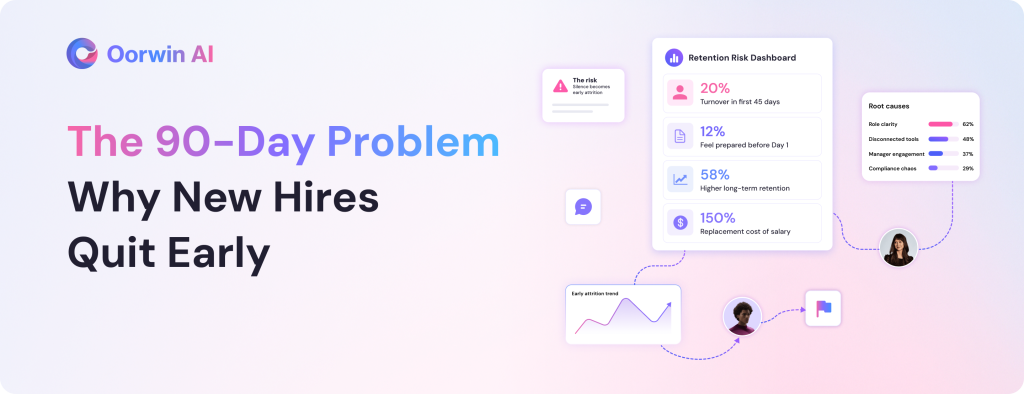
This scenario isn’t rare. According to Gallup, only 12% of employees strongly agree that their company does a great job preparing them before Day 1. The result? Up to 20% of employee turnover happens within the first 45 days, losses that begin not when the new hire resigns, but in the silence between offer and start date
In 2026, there is no excuse for pre-onboarding to be an afterthought. The companies winning the talent war have figured out something their competitors haven’t: what happens between offer acceptance and Day 1 is not an HR administrative task. It is your single most powerful retention lever.
This blog breaks down why the critical window before Day 1- what the industry now calls pre-onboarding or pre-boarding, is where retention is won or lost, how traditional onboarding fails by starting too late, and how Oorwin’s integrated platform gives HR teams the tools to turn new hires into long-term contributors before they ever set foot in the building.
The 90-Day Problem: Why New Hires Quit Early
The Numbers Don’t Lie
The data on early attrition paints a stark picture:
- Up to 20% of turnover happens within the first 45 days of employment
- Companies replacing a mid-level employee spend an average of 150% of that person’s annual salary on recruitment, training, and lost productivity
- Only 12% of employees strongly agree their organisation handles pre-onboarding well
- Employees who go through structured pre-onboarding are 58% more likely to still be with the company three years later.
Root Causes of Early Attrition
Early attrition is rarely about compensation. When exit interviews are analysed, the most common themes are:
- Unclear role expectations: New hires didn’t know what “good” looked like in week one
- Disconnected tools: HR, IT, payroll, and training platforms living in separate silos
- Lack of manager engagement: No structured check-ins in the first 30, 60, or 90 days
- The invisibility problem: Remote and hybrid hires feeling isolated with no pre-onboarding connection to their team
- Compliance chaos: Missing documents, late payroll processing, or unclear benefits enrolment
Why Traditional Pre-Onboarding Fails: The Cost of Starting Too Late
Most legacy onboarding approaches share one fatal flaw: they start on Day 1. By then, the candidate has already spent one to three weeks in silence, no welcome, no preparation, no signal that the organisation is ready for them. That gap is where doubt seeds itself. Paper-based processes, email chains, and shared-drive checklists only deepen the problem when they finally arrive.
The core failures of traditional onboarding, starting with the biggest one: it starts too late.
- No single source of truth for compliance documents, training status, and task completion
- Generic, one-size-fits-all flows that ignore role, location, seniority, or department differences
- Zero visibility for HR managers into what’s actually been completed vs. what’s fallen through the cracks
- No automated escalation when tasks are missed or milestones aren’t hit
The Cost of Getting Pre-Onboarding Wrong
A company hiring 200 employees per year at an average salary of $70,000 and experiencing just 15% first 90-day turnover is losing approximately $3.15 million annually in replacement costs alone, before accounting for lost productivity, manager time, and team disruption.
What Pre-Onboarding Actually Means in 2026
1. Beyond E-Signatures: The New Definition
In 2026, pre-onboarding is not a welcome email sent the night before Day 1. True pre-onboarding is the structured, automated activation of the entire new hire relationship from the moment a candidate signs their offer letter, covering everything that needs to happen before they walk through the door, through to their 90-day performance milestone.
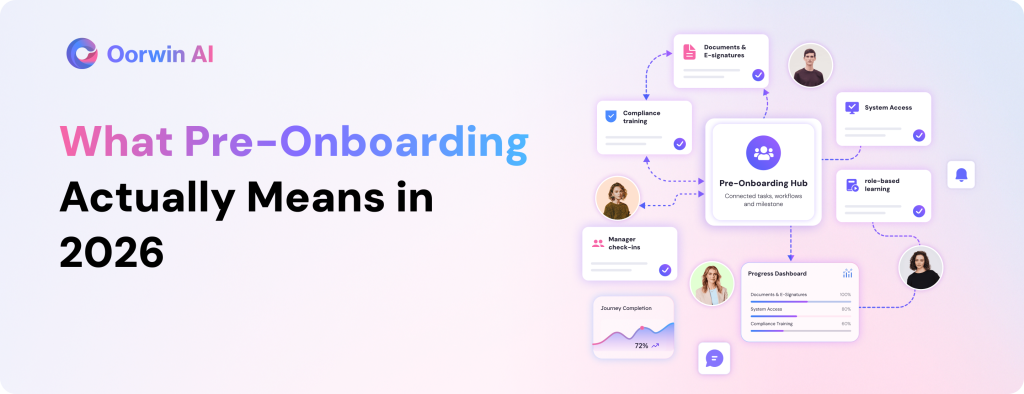
A comprehensive pre-onboarding platform covers:
- Document collection and e-signature workflows
- Equipment and system access provisioning triggers
- Compliance training assignment and tracking
- Role-specific learning paths and milestone goals
- Manager check-in scheduling and pulse surveys
- Real-time progress dashboards for HR and team leads
2. From Reactive to Proactive: The Paradigm Shift
The old model of pre-onboarding was reactive or more accurately, it barely existed. HR waited for Day 1, then scrambled. The new hire waited in silence, then arrived anxious. In 2026, the best platforms flip this entirely.
Proactive pre-onboarding means the platform anticipates what the new hire, the manager, and HR need to do and triggers the right action at the right time, automatically, starting from the moment the offer is signed. No silence. No scramble. No missed steps.
3. Personalization as the New Standard
A remote software engineer joining from a competitor needs a fundamentally different pre-onboarding experience than an on-site warehouse supervisor fresh out of college. In 2026, Oorwin configures these flows automatically based on role, department, seniority, location, and skills identified during the hiring process, so every new hire receives a pre-onboarding journey built specifically for them.
How Oorwin’s Pre-Onboarding Works: A Feature Deep Dive
1. Seamless ATS-to-HRMS Handoff
In most organizations, the moment a candidate is marked as “hired” is also the moment data chaos begins, recruiters copy information into new systems, HR manually re-enters it elsewhere, and something always gets lost in translation.
Oorwin eliminates this entirely. Because the ATS and HRMS share a single data layer, the moment a candidate is marked Hired in the Oorwin ATS, a complete pre-onboarding workflow triggers automatically. The candidate’s profile, resume, interview notes, offer details, and compensation data carry forward instantly, zero duplication, zero data loss, zero delay before the pre-onboarding clock starts.
2. Automated Task Management Across All Stakeholders
Pre-onboarding coordination involves at minimum four groups of people: HR, IT, the hiring manager, and the new hire, all of whom need to act in the window before Day 1. Traditionally, coordinating across all four requires constant email follow-up. Oorwin replaces that with automated task queues that fire the moment an offer is accepted.
Each stakeholder gets their own customized checklist with deadlines, automated reminders, and completion tracking. If a task isn’t completed by its due date, Oorwin escalates automatically. HR always knows, in real time, what’s done and what’s at risk.
3. Pre-Day 1 Document Collection and Compliance
Compliance paperwork is the most error-prone and time-consuming part of pre-onboarding preparation and the highest-stakes. But here’s what most organisations get wrong: it should never land on Day 1. Sending a new hire a stack of forms on their first morning signals disorganisation and kills the excitement they walked in with. Oorwin triggers the entire document collection workflow the moment an offer is accepted, before the candidate has even chosen what to wear on Day 1. A missed I-9, an unsigned offer letter, or a late background check authorization can create legal exposure for the entire organization.
Oorwin handles e-signatures, ID verification, offer letter acceptance, benefits enrolment, and jurisdiction-specific compliance requirements inside a single workflow. An audit trail is maintained automatically, making compliance reviews fast and defensible.
4. Role-Based Learning Path Automation
Pre-onboarding does not stop at paperwork. The days between offer acceptance and Day 1 are the perfect window to get a new hire oriented before they arrive. Oorwin integrates with your training systems and assigns role-specific learning modules automatically in this pre-Day 1 window, based on the job title and skill gaps identified during the recruiting process. When the new hire walks in on Day 1, they already know their tools, their team structure, and what success looks like in their role.
Training progress is tracked in real time and visible to both HR and the hiring manager eliminating the “I thought they already completed that module” conversations that slow productivity ramp-up.
5. Automated 30/60/90-Day Check-In Workflows
The 30-60-90-day milestones are the most critical checkpoints in the early employee lifecycle and the most commonly skipped. Managers get busy. HR moves on to the next hire. The new employee feels forgotten.
Oorwin auto-schedules structured check-ins at each milestone, sending pulse surveys to the new hire and conversation prompts to the manager. But engagement does not wait for a milestone, Oorwin keeps the candidate warm from the moment the offer is signed, sending personalised emails, welcome content, and role-relevant resources throughout the pre-boarding window so they arrive on Day 1 already connected to the organisation. If survey responses signal disengagement or confusion, Oorwin flags it for HR intervention before the employee starts quietly job hunting.
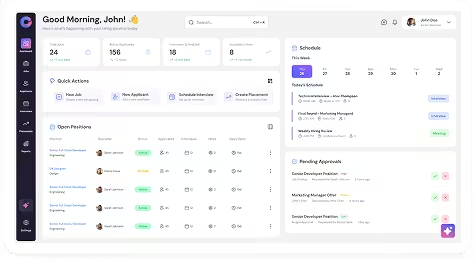
6. Unified Real-Time Pre-Onboarding Dashboard
Every party in the pre-onboarding process HR, the hiring manager, and the new hire, sees a single live dashboard that shows exactly where things stand before Day 1. Task completion percentages, document status, training progress, upcoming milestones, and any flagged risks are all visible at a glance.
This eliminates the most common pre-onboarding failure: the assumption that someone else handled it.
The Retention Math: What Getting Pre-Onboarding Right Is Worth
The ROI of getting pre-onboarding right is not soft or theoretical it is measurable, significant, and compounding. Pre-onboarding is the foundation that makes structured onboarding work, and the research on what that delivers is clear.
The Numbers
Employees who go through a structured pre-onboarding process are 58% more likely to still be with the company after 3 years.
Strong pre-onboarding improves new hire productivity by more than 70% compared to unstructured approaches.
Organisations that start pre-onboarding at offer acceptance close the gap to full productivity in 1–2 weeks – versus the industry norm of 4–6 weeks for those who wait until Day 1.
The Math for a Mid-Size Hiring Organization
Consider a company that hires 200 employees per year. Industry benchmarks put first-90-day turnover at roughly 15–20% for organisations with no structured pre-onboarding process.
What changes is speed. Organisations using Oorwin’s pre-onboarding workflows consistently close the gap between offer acceptance and full productivity within one to two weeks, compared to the industry norm of four to six weeks of fragmented, slow starts. That is not a marginal improvement. It is the difference between a new hire who hits the ground running and one who is still waiting for their laptop password on week three.
And when every new hire ramps up one to two weeks faster, the cumulative productivity gain across a full year of hiring is substantial, without spending a single additional pound on recruitment.
A Real-World Scenario: Staffing Firm Transformation
Consider a mid-size staffing firm placing 30 to 50 contractors per month across client sites in multiple cities. Before implementing Oorwin, their pre-onboarding process looked like this:
- Pre-onboarding a single contractor required 5 to 7 days of back-and-forth emails
- Compliance documents were frequently missing or submitted after the start date
- New contractors regularly showed up to client sites without system access or clear instructions
- HR was spending 10 to 12 hours per hire on administrative tasks
- Client satisfaction scores were declining as contractors arrived unprepared
After Implementing Oorwin
The transformation was immediate and measurable:
- Pre-onboarding workflows triggered automatically at placement confirmation, no manual handoff required
- Contractors completed all paperwork via mobile within 24 hours of offer acceptance
- System access and equipment requests were triggered automatically before Day 1, so contractors arrived ready to work
- Managers received automated Day 7, Day 30, and Day 60 check-in prompts with structured conversation guides
- HR time spent on pre-onboarding administration dropped by over 60%
The result: 90-day contractor retention improved significantly, client satisfaction scores rebounded, and the HR team redirected their saved hours toward strategic talent advisory work, the work they were actually hired to do.
6 Pre-Onboarding Best Practices for 2026
Regardless of your current pre-onboarding maturity, these six practices will close the gap between offer acceptance and a confident, prepared new hire walking in on Day 1:
- Send system credentials, welcome materials, team introductions, and first-week schedules the week before the start date. Preboarding reduces first-day anxiety and signals organizational competence. Start before Day 1.
- Peer connections are the fastest path to cultural integration. Schedule this inside Oorwin so it doesn’t fall through the cracks when the manager gets pulled into other priorities. Assign a formal pre-onboarding buddy.
- Ambiguity about expectations is the top driver of early disengagement. Store these goals in the employee’s Oorwin profile so HR, the manager, and the new hire are aligned from the start. Set 30/60/90 goals in writing on Day 1.
- Use Oorwin’s role-based pre-onboarding templates for efficiency but customize the welcome communication for each hire. Automation and human warmth are not mutually exclusive. Automate the workflow, personalize the message.
- Track task completion rates, training progress, time-to-productivity, and 90-day pulse survey scores inside Oorwin’s analytics dashboard. You cannot improve what you don’t measure. Measure everything.
- Use early attrition data and exit interview themes to continuously refine your pre-onboarding templates. The best pre-onboarding programmes improve every quarter. Close the feedback loop.
Oorwin vs. Manual Pre-Onboarding: Side-by-Side
| Factor | Manual Onboarding | Oorwin Pre-Onboarding |
| Time to complete paperwork | 3 to 5 business days | Under 24 hours |
| Compliance error rate | High- manual tracking | Near zero- automated reminders |
| Manager visibility | None, email-dependent | Full real-time dashboard |
| Personalization | Generic, one-size-fits-all | Role and location-based flows |
| 30/60/90-day check-ins | Ad hoc, often skipped | Auto scheduled with structured prompts |
| HR admin hours per hire | 10 to 12 hours | 2 to 3 hours |
| Early attrition detection | Reactive, after resignation | Proactive, pulse survey flags |
| Cross-system data entry | Manual, error-prone | Zero, single data layer |
The Bottom Line: Pre-Onboarding Is Your First Retention Decision
The 90-day window is not a grace period; it is the most decisive phase in the entire employee lifecycle. Every interaction, every missed check-in, every unanswered question during those first month’s shapes whether a new hire becomes a long-term contributor or another line item in your attrition report.
Oorwin closes the gap between “hired” and “engaged” with a pre-onboarding platform that automates the operational, personalises the human, and gives every stakeholder the visibility they need to act before problems become departures. And it begins not when the new hire walks through the door, but the moment they sign the offer.
Companies that treat pre-onboarding as a strategic retention decision, not an afterthought that begins on Day 1, will win the talent war in 2026 and beyond. The ones that don’t will keep losing people they worked hard to hire, in the silence between offer and start date.
Ready to Transform Your Pre-Onboarding?
See how Oorwin’s pre-onboarding workflows eliminate the silence between offer and Day 1 and turn every new hire into a confident, prepared, connected team member before they ever walk through the door.
Book a free Oorwin demo at www.oorwin.ai