
There is a conversation happening in boardrooms right now that almost no one is having out loud. It goes something like this: recruitment costs are climbing, turnover is high, and the talent team is being asked to hire faster, hire better, and do it all with a budget that hasn’t kept pace with the ambition. Meanwhile, somewhere else in the organization, the investment in keeping the people already through the door remains an afterthought, a line item reviewed annually, adjusted modestly, and defended cautiously.
This is the loyalty paradox. And it is costing organizations far more than they realize.
The companies spending the least on retention are, without exception spending the most on recruitment. The tragedy is that most of them never connect the two.
The Paradox, Defined
Loyalty, in the employment context, has always been a two-way street. Employees offer their time, energy, expertise, and commitment. Organizations offer compensation, opportunity, recognition, and the conditions for people to do meaningful work. When both sides of that exchange are honoured, something remarkable happens people stay. They grow. They become the institutional knowledge, the cultural anchors, and the high performers that organizations spend enormous energy trying to find externally.
The paradox emerges when organizations invest heavily in attracting talent but minimally in sustaining it. They build sophisticated employer brands to lure candidates through the front door while leaving the back door quietly open. They pour budget into sourcing, advertising, and agency fees for roles that exist, in part, because the investment in keeping the last person was never made.
It is, in the most literal sense, a self-defeating strategy. And yet it persists across industries, geographies, and company sizes with remarkable consistency.
Why It Happens
Understanding the loyalty paradox requires understanding how organizations account for the cost of people. Recruitment spend is visible. It appears in budgets, in agency invoices, in job board subscriptions, in the hours logged by talent acquisition teams. It is tracked, reported, and reviewed.
The cost of turnover is largely invisible. The lost productivity during the vacancy period. The institutional knowledge that walked out the door with the departing employee. The time a manager spends onboarding a replacement instead of leading their team. The morale dip that ripples through a team when a respected colleague leaves. The mistakes a new hire makes in their first six months that a retained employee would never have made. None of these appear on a balance sheet. None of them are reported in a quarterly review. And because they are invisible, they are consistently underestimated.
This accounting asymmetry is at the heart of the paradox. Organizations optimize for what they can measure. Recruitment spend is measurable. Retention ROI is not, at least not without deliberate effort to make it so. And so, the budget flows to the visible problem, while the invisible one compounds quietly in the background.
Organizations don’t under-invest in retention because they don’t care about their people. They under-invest because the cost of losing them never appears on a single line of the P&L.
The Human Cost Behind the Financial One
It would be a mistake to reduce the loyalty paradox to a financial calculation, because the human cost runs deeper than any spreadsheet can capture.
When people leave an organization, they rarely do so without warning. There is almost always a period weeks, sometimes months, during which the decision is being made. During that period, a person who was once fully engaged becomes quietly disengaged. They stop volunteering for stretch projects. They stop advocating for the company in conversations with their network. They stop bringing their best thinking to the problems on their desk. They are still present. But they are no longer there.
This quiet disengagement is one of the most expensive states in organizational life, and one of the least discussed. It sits between full contribution and formal resignation, costing the organization the best of what the employee has to offer while the departure is still weeks away. And it is almost entirely preventable, not through perks or ping-pong tables, but through the kind of genuine investment in people that signals, clearly and consistently, that their presence matters beyond their output.
The organizations that understand this don’t wait for disengagement to become resignation. They build the conditions that prevent disengagement from taking root in the first place. They create environments where people feel seen, challenged, and connected to something larger than their individual role. And they use technology not to replace that human connection, but to protect it by freeing leaders from administrative burden so they can invest in the relationships that retention actually depends on.
What Loyalty Actually Requires
The word “loyalty” can feel old-fashioned in a world of portfolio careers, remote work, and a talent market that has shifted decisively in favour of the candidate. But loyalty, properly understood, is not about tenure. It is not about employees staying forever regardless of their own growth and ambitions. It is about the quality of the relationship between an organization and its people for as long as that relationship serves both parties.
That kind of loyalty cannot be bought. It cannot be mandated. It cannot be manufactured with an annual bonus or a flexible Friday. It is built, slowly and deliberately, through a series of consistent signals that tell people: we see you, we value you, and we are invested in your success here.
Those signals take many forms. A manager who has a genuine conversation about career development, not during the annual review, but regularly, informally, as a matter of course. A promotion process that is transparent and merit-based rather than opaque and political. An onboarding experience that treats a new hire as an individual rather than a unit of headcount. A recognition culture that connects people’s daily work to the organization’s larger purpose. A feedback loop that is honest rather than comfortable.
None of these are revolutionary ideas. What is revolutionary is the consistency with which high-retention organizations actually practice them and the consistency with which low-retention organizations do not.
The Role of Technology in Breaking the Cycle
There is a version of the loyalty conversation that ends here, with a call for better management, stronger culture, and more human leadership. That version is correct. But it is incomplete.
Because one of the most persistent barriers to retention investment is not a lack of will. It is a lack of visibility. HR leaders who want to build retention programmes cannot build what they cannot see. They cannot intervene in disengagement they haven’t detected. They cannot personalize the employee experience if they don’t have connected data about what each individual needs. And they cannot make the business case for retention investment if they cannot quantify the cost of turnover in terms that the CFO will recognize.
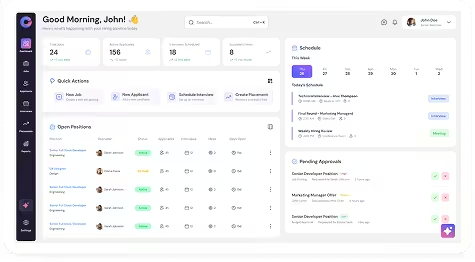
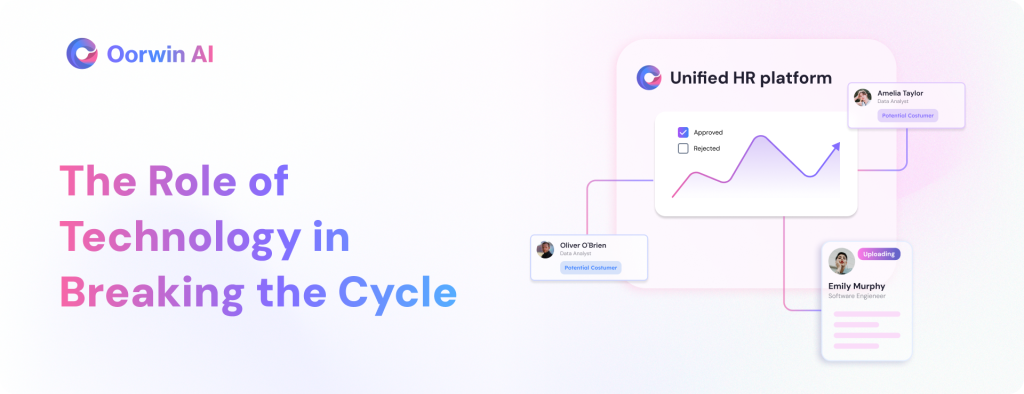
This is where technology becomes not a substitute for human leadership, but an enabler of it. A unified HR platform that connects recruitment data to onboarding outcomes, tracks engagement signals across the employee lifecycle, and surfaces the patterns that precede disengagement doesn’t replace the manager’s conversation. It makes that conversation possible, better informed, better timed, and more likely to land before it’s too late.
Oorwin was built on the understanding that talent strategy cannot be divided into acquisition and retention as if they were separate functions. The moment a candidate accepts an offer, they begin their journey as an employee. The data gathered during recruitment like their motivations, their career goals, the promises made during the interview process should inform how they are onboarded, developed, and recognized throughout their tenure. When that data flows continuously from hiring to HR management, organizations stop treating retention as a reaction to departure and start treating it as a natural extension of the hiring relationship.
Retention doesn’t begin when someone hands in their notice. It begins the moment they accept your offer. Every interaction between those two moments is either building loyalty or quietly eroding it.
Breaking the Cycle
The loyalty paradox is not inevitable. It is a structural problem created by structural choices in how organizations account for talent costs, in how they design the employee experience, and in how they deploy the technology available to them.
Breaking the cycle begins with a single, honest question: what does it actually cost us when a person leaves?
Not the recruitment fee for their replacement. Not the days the role sits open. The full cost- the knowledge lost, the relationships disrupted, the productivity gap, the team morale, the candidate experience of everyone who interviews for the backfill role. When that number becomes visible, the case for retention investment stops being a soft argument about culture and becomes a hard argument about economics.
The organizations that will build the strongest talent foundations over the next decade are not the ones with the most aggressive recruiting machines. They are the ones that recognize the leaky bucket for what it is and choose, deliberately, to patch it.
They hire well. They onboard intentionally. They develop consistently. They recognize genuinely. And when someone eventually does move on because some will, and that is right they do so as advocates, not critics. Alumni who speak well of the organization. Candidates who return. Referrers who send their best people in.
That is what loyalty, in the modern employment relationship, actually looks like. Not permanence. Not blind commitment. Just a relationship honoured on both sides, for as long as it lasts.
The goal was never to stop people from leaving. It was always to make staying the obvious choice. Build the conditions for that and the paradox resolves itself.
Ready to connect your recruitment and retention strategy into one unified approach? See how Oorwin helps HR leaders build the talent foundations that make loyalty the natural outcome.