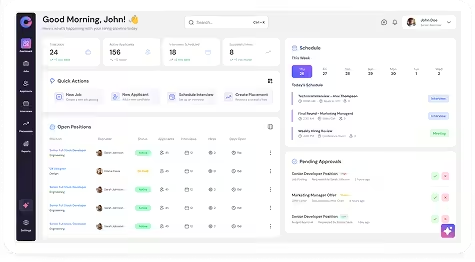

A job requisition is a formal internal document that a hiring manager or department submits to request approval for filling a new or vacant position. It marks the official starting point of the recruitment process, before a job is posted publicly or a single candidate is sourced.
In simple terms, a job requisition is how an organization asks the question- do we have the need, the budget, and the approval to hire? – before recruitment begins.
Job Requisition vs. Job Description vs. Job Posting
These three terms are closely related but serve different purposes and audiences.
A job requisition is an internal document. It’s used within the organization to justify the hire, get approval from HR, finance, and leadership, and define the role before it goes anywhere near a candidate.
A job description is a detailed profile of the role, responsibilities, skills required, reporting structure, and expectations. It’s created from the approved requisition and used both internally and externally.
A job posting is the public-facing advertisement. It’s what candidates see on job boards, career pages, and social media, designed to attract applicants.
The requisition comes first. Everything else follows from it.
What a Job Requisition Typically Includes
A well-prepared job requisition gives HR and leadership everything they need to review and approve the hire quickly. It typically covers:
- Job Title and Department – What the role is and where it sits in the organization.
- Type of Employment – Full-time, part-time, contract, or temporary.
- Reason for the Request – New headcount, backfill for a departing employee, or a role created to support business growth.
- Key Responsibilities and Skills – A summary of what the role requires, used to write the job description after approval.
- Salary Range – The budgeted compensation for the position, used for finance sign-off.
- Reporting Structure – Who the role reports to and any direct reports it will manage.
- Target Start Date – When the hire is needed, which informs the urgency of the process.
- Approval Chain – Who needs to sign off- department head, HR, finance, or leadership depending on the organization.
Missing or vague information in any of these areas slows the approval process down and increases the likelihood of a mismatched hire later.
The Job Requisition Process
1. Need Identification
The hiring manager identifies a gap, a team is under-resourced, a role has become vacant, or a new business initiative requires new skills. The decision to hire is based on actual business need, not assumption.
2. Requisition Submission
The hiring manager completes the requisition form with all required details and submits it for review. In most organizations, this is done through an HRMS or ATS.
3. Approval Workflow
The requisition moves through an approval chain, typically HR, finance, and senior leadership to confirm the hire is justified, budgeted, and aligned with workforce planning.
4. Recruitment Activation
Once approved, HR uses the requisition as the basis for writing the job description and job posting. Sourcing begins only after this stage is complete.
Why Job Requisitions Matter
Hiring without a formal requisition process creates problems that compound quickly, unclear role requirements, misaligned expectations between departments, unauthorized headcount, and compliance risks.
A structured requisition process ensures:
- Budget alignment – Every hire is financially approved before recruitment costs are incurred.
- Role clarity – Recruiters know exactly what they’re sourcing for, which improves the quality of candidates entering the pipeline.
- Cross-department alignment – HR, finance, and the hiring manager are working from the same brief, reducing back-and-forth once recruitment is underway.
- Compliance – Documented approval trails protect organizations during audits and ensure hiring decisions follow internal policy.
Common Bottlenecks in the Requisition Process
The approval stage is where most requisitions stall. Unclear authority levels, missing budget information, or poor justification for the role send requisitions back for rework, adding days or weeks before recruitment can even start.
Firms that automate their approval workflows, routing requisitions to the right stakeholders with automated reminders and status tracking, significantly reduce this delay and keep hiring timelines on track.
The Bottom Line
A job requisition is not an administrative formality. It is the governance checkpoint that ensures every hire is intentional, approved, and aligned with the business before a single recruiter hour is spent. When done well, it makes every step that follows like sourcing, screening, interviewing, and placing faster and more precisely.
To learn more about how Oorwin streamlines job requisition and recruitment workflows, visit oorwin.ai