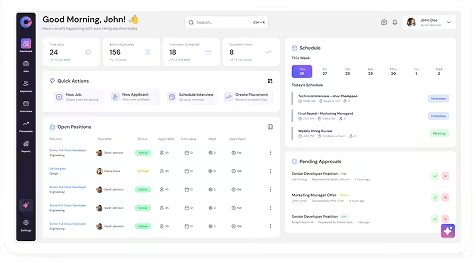
Staffing software is a technology platform built specifically for staffing and recruiting firms to manage their entire hiring operation — from sourcing candidates and tracking applicants to onboarding new hires, managing client relationships, and handling billing.
In simple terms, it replaces disconnected spreadsheets, email threads, and manual processes with one system that keeps every part of the recruitment workflow connected and visible.
Staffing Software vs. a Standard ATS
A common misconception is that staffing software and an Applicant Tracking System (ATS) are the same thing. They’re not.
An ATS handles one part of the process- tracking candidates from application to hire. It’s a front-office tool focused on recruitment.
Staffing software is an end-to-end platform. It includes an ATS, but also covers client management, onboarding, compliance, timesheets, payroll, billing, and reporting, everything a staffing firm needs to operate, not just hire.
If an ATS manages the candidate, staffing software manages the entire business around the candidate.
What Staffing Software Typically Includes
Front-Office Tools
These are the features recruiters use daily to source, screen, and place candidates:
- Applicant Tracking System (ATS) – Manages job postings, candidate pipelines, and placement activity.
- Customer Relationship Management (CRM) – Tracks client accounts, contacts, sales opportunities, and business development activity.
- Candidate Sourcing – Job board integrations, resume harvesting, and AI-powered candidate matching to fill roles faster.
- Interview Scheduling – Coordinates interviews between candidates and hiring managers without manual back-and-forth.
- Communication Tools – Email, SMS, and calling integrated into candidate and client records for a complete interaction history.
Onboarding and Compliance
- Paperless Onboarding – Digital collection of employment forms, tax documents, and policy acknowledgements.
- E-Signatures – Legally binding digital signatures on contracts and offer letters.
- Compliance Tracking – Monitors I-9 verification, work authorizations, and background check statuses.
- Document Management – Centralized, access-controlled storage for all candidate and employee records.
Back-Office Operations
- Timesheet and Attendance – Tracks contractor hours for billing and payroll accuracy.
- Invoice Generation – Automates client billing based on placement and timesheet data.
- Expense Management – Captures and approves expense claims tied to placements or projects.
- Reporting and Analytics – Real-time dashboards tracking fill rates, placement success, revenue, and recruiter performance.
Who Uses Staffing Software
Staffing software is used across multiple roles within a firm, each interacting with the platform differently:
- Recruiters use it to source candidates, manage pipelines, schedule interviews, and track placements.
- Account Managers and Sales Teams use the CRM to manage client relationships, track opportunities, and log business development activity.
- HR and Operations Teams use it to manage onboarding, compliance, timesheets, and employee records.
- Leadership and Finance use reporting and analytics to monitor firm-wide performance, margins, and revenue.
Why Staffing Firms Need Dedicated Software
General HR tools are built for internal hiring, filling roles within a single organization. Staffing firms have a fundamentally different operational model: they’re managing hiring for multiple clients simultaneously, across multiple roles, with candidates who may be placed, redeployed, or sitting on the bench between assignments.
That complexity requires purpose-built software. A general HRMS or a basic ATS doesn’t account for client billing, contractor redeployment, bench management, multi-client compliance, or the kind of high-volume pipeline activity staffing firms run daily.
Staffing software is built for that specific operational reality, not adapted from a tool built for something else.
What Good Staffing Software Looks Like
The right platform for a staffing firm does three things well:
- Connects front-office and back-office in one system- so data doesn’t have to be manually transferred between recruiting, HR, and finance.
- Scales with the business- handling growth in clients, roles, and team size without requiring a platform change.
- Reduces manual work- automating repetitive tasks like job posting, reminders, compliance tracking, and invoice generation so recruiters spend time on placements, not administration.
The Bottom Line
Staffing software is the operational backbone of a staffing firm. The right platform doesn’t just make individual tasks easier, it connects every part of the business into one coherent workflow, giving teams the speed, visibility, and accuracy they need to place the right candidates and keep clients coming back.
To learn more about how Oorwin’s staffing platform supports end-to-end hiring operations, visit oorwin.ai