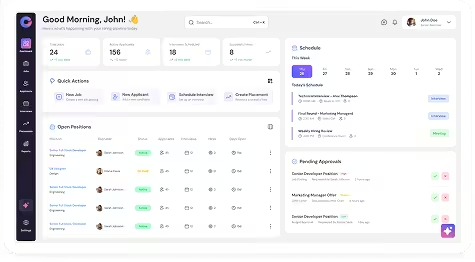
A tech stack integration is the process of connecting multiple software tools and platforms, so they share data, communicate with each other, and work as a unified system, rather than as separate tools that each require manual input and switching.
In staffing and HR, a tech stack typically includes tools for applicant tracking, candidate relationship management, job board distribution, payroll, compliance, and reporting. Integration is what makes these tools work together instead of alongside each other.
In simple terms, tech stack integration means your tools talk to each other, so your team doesn’t have to manually bridge the gaps between them.
Why Tech Stack Integration Matters
Most staffing firms and HR teams use more than one platform to manage their hiring operations. Without integration, data entered in one tool has to be manually re-entered in another. Candidate records sit in one system while interview notes live in a different one. Payroll doesn’t know what the ATS has closed. Compliance documents aren’t connected to the onboarding workflow.
Each disconnection adds manual work, introduces errors, and slows down the process.
When tools are properly integrated, data flows automatically across systems. A candidate sourced on LinkedIn enters the ATS without manual input. An offer accepted in the recruiting platform triggers the onboarding workflow. A placement confirmed in the ATS updates the billing record in real time.
For staffing firms managing high volumes of job orders across multiple clients, that automation compounds quickly into measurable time savings, fewer errors, and faster placements.
Key Components of a Recruiting Tech Stack
A well-integrated recruiting tech stack typically connects the following:
1. Applicant Tracking System (ATS)
The foundation of any recruiting stack. It tracks candidates from application through placement and serves as the central system of record for hiring activity.
2. Customer Relationship Management (CRM)
Manages client relationships, sales pipelines, and business development activity. Integration with the ATS means client requirements and candidate submissions are visible in the same workflow.
3. Job Board Integrations
Connects the ATS to external job boards so positions can be posted and candidates can be sourced across multiple platforms from one place, without logging into each board separately.
4. HRMS / Payroll
Links placement and onboarding data to employee records, timesheets, and payroll, eliminating manual data transfer between recruiting and HR operations.
5. Communication Tools
Email, VoIP, and messaging platforms integrated into the ATS keep all candidate and client communication logged in one place, tied to the relevant record.
6. Compliance and Document Management
Background check platforms, e-signature tools, and compliance systems connected to onboarding workflows ensure documents are completed, stored, and tracked without a separate manual process.
Best-of-Breed vs. Unified Platform
Staffing firms typically approach their tech stack in one of two ways.
Best-of-breed means selecting the strongest individual tool for each function and integrating them together. This approach offers flexibility but requires significant effort to maintain integrations and keep data consistent across systems.
Unified platform means using a single platform that handles multiple functions natively- ATS, CRM, HRMS, compliance, and reporting all within one system. This reduces integration complexity and ensures data consistency without relying on third-party connectors.
Most high-performing staffing firms use a combination of a core unified platform handling the majority of functions, with selective integrations to specialized tools where needed.
What to Look for in Tech Stack Integration
- Data consistency- Does data entered in one tool reflect accurately across all connected systems without manual reconciliation?
- Ease of setup- Can integrations be configured without heavy IT involvement?
- API availability- Does the platform offer open APIs for custom integrations with tools specific to your workflow?
- Compliance alignment – Do integrations respect data privacy regulations like GDPR and CCPA, especially when data moves across borders?
- Scalability – Can the stack grow as the firm adds clients, recruiters, and markets without requiring a full rebuild?
A Connected Stack, Not Just a Collection of Tools
A tech stack is only as strong as the connections between its parts. Individual tools solve individual problems. An integrated stack solves the workflow, removing the manual steps, the context switching, and the data gaps that slow recruiting teams down and create errors that cost client relationships.
To learn more about how Oorwin integrates with your existing tools and platforms, visit oorwin.ai